NeoTracker: a digital delivery room event log
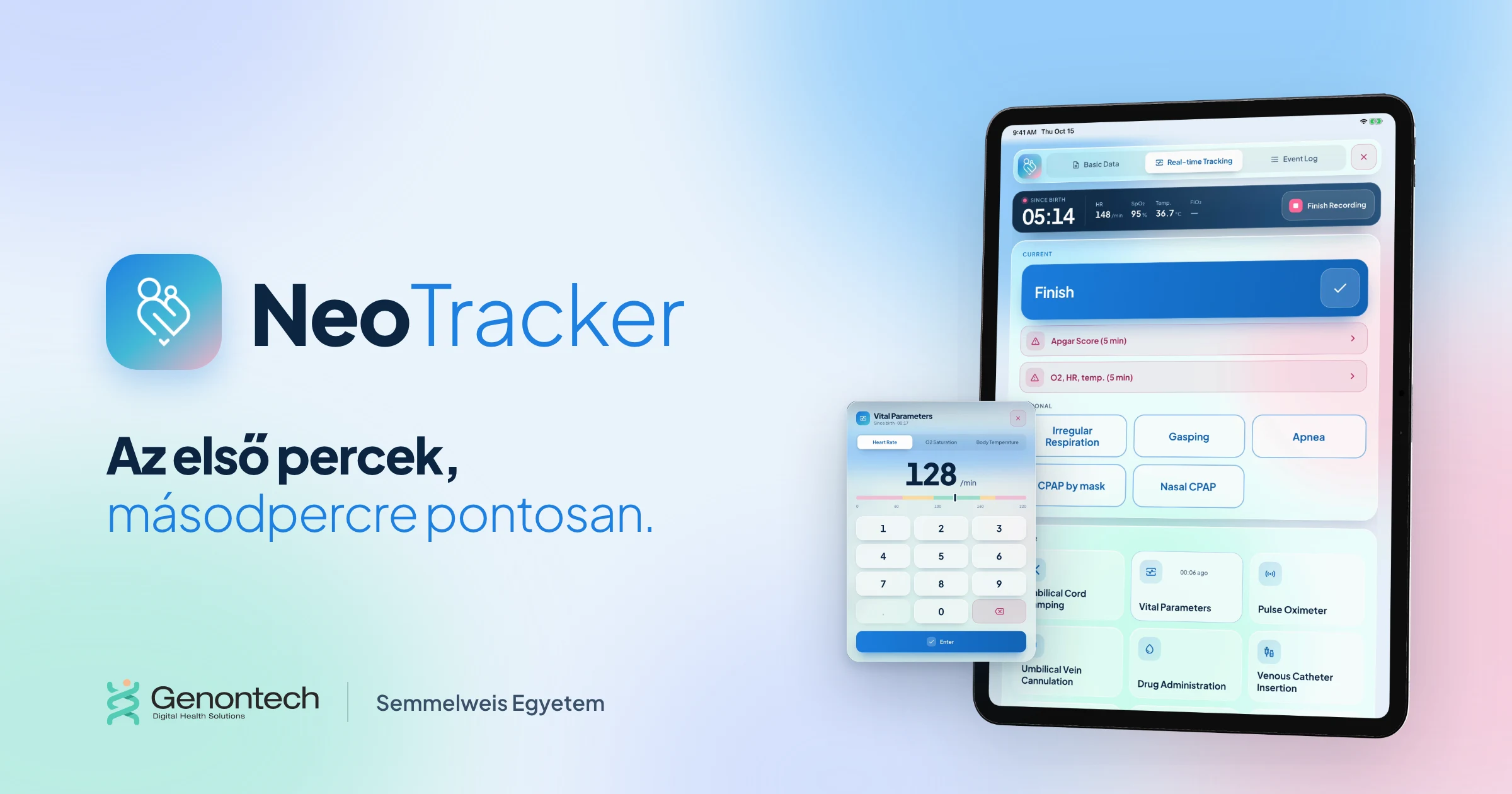
During delivery room stabilization of a newborn, clinicians have to make decisions fast, and there is often no time to document the interventions in detail until hours later. Reconstructing exactly what happened, and reviewing the care afterward, requires real-time, structured, time-stamped data. NeoTracker was built to meet this need, developed jointly by clinical specialists at Semmelweis University and Genontech. The application records the events, interventions and key physiological parameters of newborn care, following the logic of Newborn Life Support.
Why real-time documentation matters in the delivery room
In care after birth, the timing of an intervention, the sequence of changes in the baby's condition and the measured values together explain what happened to the newborn. When documentation is written up afterward from memory, details can be lost and times can become inaccurate. This makes it harder for the team to review cases together and to use the data for research.
The needs assessment behind the project was carried out at the Üllői út site of the Department of Obstetrics and Gynecology, Semmelweis University. According to the center's 2023 data, 291 newborns out of 2,906 births, or 10%, required complex delivery room care and subsequent admission to the neonatal intensive care (NIC) unit.1 This figure comes from a single institution, but it clearly shows how much detailed documentation matters locally.
291 newborns out of 2,906 births required complex delivery room care and NIC admission — Semmelweis University, Üllői út site, 2023
A time-stamped event log provides well-organized data for reviewing this kind of care. It makes it possible to look back at when an intervention took place alongside the condition recorded at that moment.
How NeoTracker works
NeoTracker is a tablet application whose interface is built around Newborn Life Support (NLS), the algorithm for supporting and resuscitating newborns after birth. Its data entry options follow the steps, branches and decision points of the clinical workflow.
Once the baseline data have been entered, the user can start a timer that shows the time elapsed since birth in minutes and seconds. Each event is logged with a time stamp, and the app sends notifications when time-dependent tasks are due, such as recording Apgar scores at 1, 5 and 10 minutes.
The application brings together the documentation of care, from the antenatal consultation to the short-term outcome:
| Data domain | What it covers |
|---|---|
| Antenatal and birth information | Antenatal consultation, risk factors, birth details |
| Baseline care data | Details of the care episode and the care team, first physical exam |
| Clinical assessment | Apgar scores, oxygen saturation, heart rate, body temperature |
| Events and interventions | Time-stamped entries aligned with the NLS flowchart |
| Respiratory support | Oxygen and pressure values related to CPAP use |
| Closing the care episode | Short-term outcome, written and visual summary |
Overview of the data domains that can be recorded in NeoTracker.
Recorded data can be exported in PDF and CSV format. The written summary makes it easier to add the details of care to the patient record, while the structured dataset provides a direct basis for later analysis and research.
A joint development by Semmelweis University and Genontech
Development of NeoTracker began with a clinical needs assessment. This was followed by defining the medical data content, building an Excel-based prototype and then developing the tablet application.
The prototype helped the team test which data and entry options were needed during care. Testing also revealed its limitations: the Excel layout, organized by organ system, did not follow the sequential steps of NLS closely enough, and data entry was time-consuming.
In the application, clinical reasoning therefore became the foundation of both the interface and the logic. The clinicians described the NLS workflow as a BPMN process model. This standard process notation gave clinicians and software developers a shared frame of reference for designing the steps, decisions and branches.
Genontech contributed the technical implementation. On the company side, László Schiller-Tamás carried out and coordinated the software development. The clinical team defined and validated the medical data content and provided the conditions for testing. Close, frequent communication between the two sides sped up development and helped refine user requirements. As a result, the first version of the tablet application, tested in a clinical setting, was ready by fall 2025.1
What structured care data can be used for
Structured data can be put to use in four practical areas:
- Quality improvement: the timeline of events and interventions can support joint case reviews by the care team.
- Research: structured data can make it possible to study links between early interventions and later outcomes.
- Education: documented care processes can be used in medical and specialist nursing training.
- Patient records: the exported summary can help add the details of care to the hospital record.
Structured data collection also shapes thinking in its own right: it supports professional awareness, shared learning within the care team and the knowledge base needed for future improvements.
BioTechUSA For Health Award 2025: recognition for NeoTracker
In 2025, the NeoTracker project of the Division of Neonatology at Semmelweis University won the "Most Outstanding Healthcare Innovation of the Year" category of the BioTechUSA Az Egészségért Díj (BioTechUSA For Health Award). The awards were presented on November 20 at the Museum of Fine Arts, Budapest. According to the organizer's announcement, 55 applications were submitted, and the winners of the professional categories each received HUF 5 million in funding.2
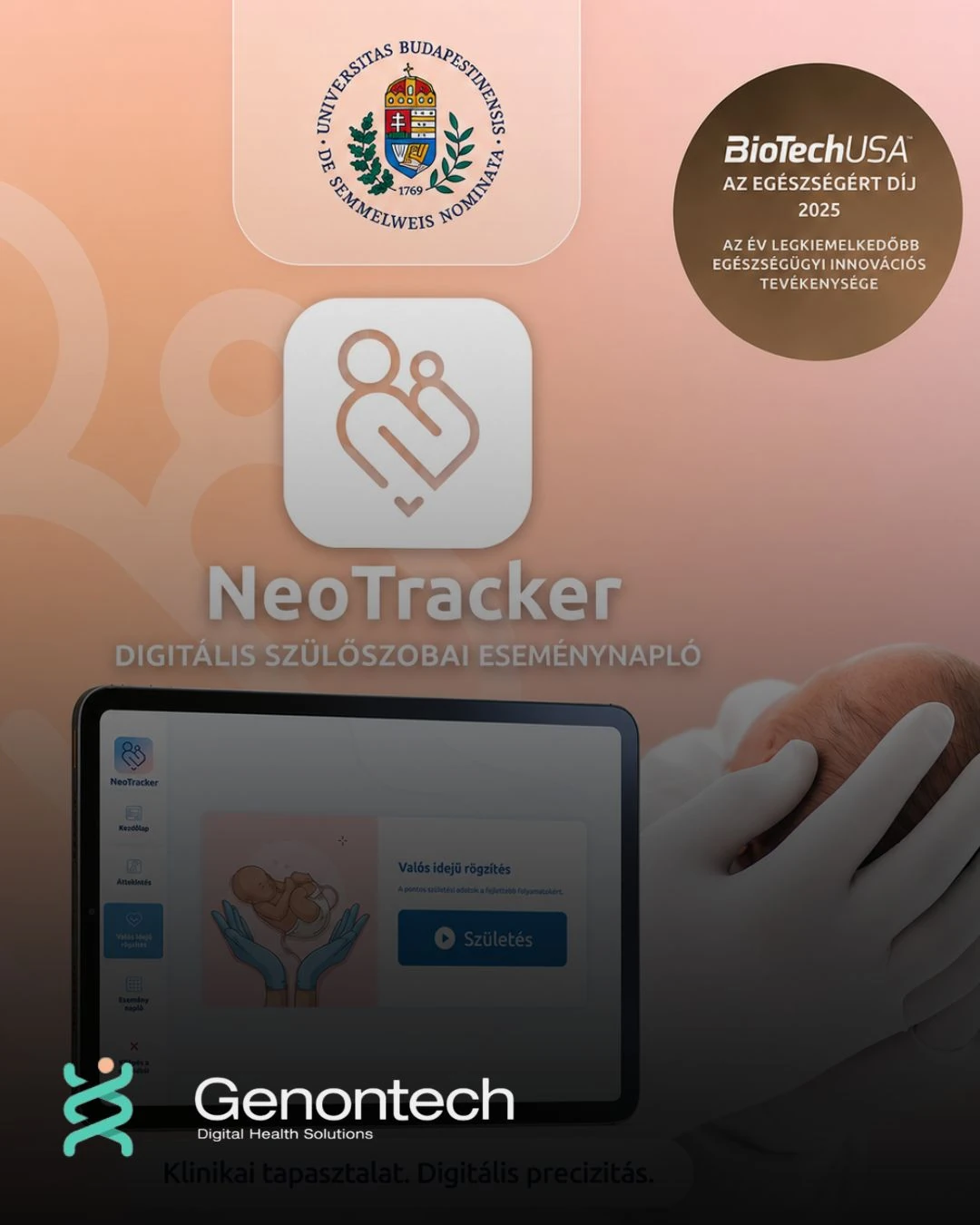
BioTechUSA For Health Award 2025 graphic for NeoTracker, jointly developed by Semmelweis University and Genontech. Image: Genontech.
This professional recognition also gives momentum to the next phase: the pilot aims to record 200–300 events, and a nationwide rollout could cover the care of as many as 75,000–80,000 newborns.2 This scale shows the significant opportunity that a jointly built digital solution creates for improving delivery room documentation.
Early experience and next development steps
By the time the manuscript was submitted, 15 care episodes had been recorded with NeoTracker at the Üllői út site of Semmelweis University. Initial experience showed that the NLS-based panels supported real-time event recording, and that Apgar scores and other numerical data could be entered quickly and accurately. The interface proved user-friendly, and colleagues with no prior involvement in the development found it easy to learn.1
The current usage model relies on a dedicated person to enter data. Developing monitor synchronization and voice-controlled data entry could make this process easier to fit into the daily work of smaller teams as well.
The next development direction is synchronization with newborn monitors, which could enable continuous, time-series recording of objective physiological parameters. Voice-controlled data entry could reduce the need for a dedicated data recorder. With these steps, NeoTracker could fit even more naturally into delivery room work, while building a more accurate database for documentation, research and further digital development.
The NeoTracker story shows how a real clinical need can become a working digital solution. Together, the clinical expertise of Semmelweis University and the development experience of Genontech took the project from needs assessment to an application tested in a clinical setting, and on to a prestigious innovation award. The next chapter could be about wider use, institutional rollout and unlocking the further potential of structured data.
Are you working on a digital health solution that starts from a clinical need?
Let's talkSources
-
Bogner Luca Laura, Pekli-Tóth Fanni, Trinh Sarolta, Schiller-Tamás László, Valek Andrea, Szabó Miklós, Nagy Zsuzsanna, Nádor Csaba, Jermendy Ágnes: NeoTracker - saját fejlesztésű digitalizált eseménynapló az újszülöttek szülőszobai stabilizációjáról (English: "NeoTracker: an in-house digital event log of neonatal stabilization in the delivery room"). Orvosi Hetilap, 2026; 167(15): 595-604. Article in Hungarian. The primary scientific source on the clinical problem, the development process, the features and early experience. CC BY 4.0. ↩ ↩2 ↩3
-
BioTechUSA: Szülőszobai eseménynapló, gyógyító kert és traumatudatos felnőttképzési rendszer is van idén a BioTechUSA az Egészségért Díj nyertesei között (English: "A delivery room event log, a healing garden and a trauma-informed adult education system among this year's BioTechUSA For Health Award winners"). November 24, 2025. Organizer's announcement about the award, the funding and the plans presented. ↩ ↩2

Author
László Schiller-Tamás is Solution Delivery Lead at Genontech. He carried out and coordinated the software development of NeoTracker for Genontech, and co-authored the Orvosi Hetilap paper this article draws on.